501 darts rules.
The proper game.
Be the first to get from 501 to exactly zero, finishing with a double.
- Players
- 2+ or teams
- Darts
- 3 a visit
- Time
- 10–20 min a leg
- Level
- Medium
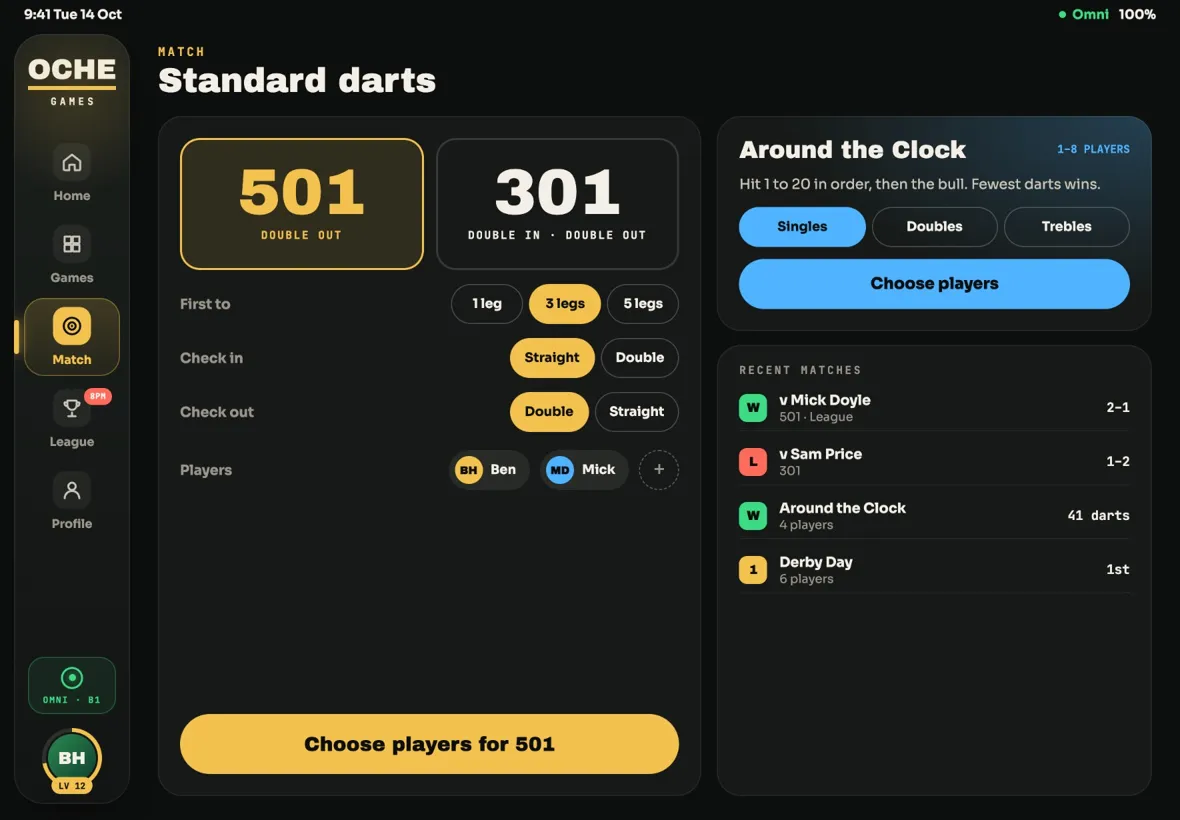
Be the first to get from 501 to exactly zero, finishing with a double.
501, step by step.
Decide who throws first
Usually whoever’s closest to the bull. The loser of the bull throws first in the next leg.
Everyone starts on 501
Take turns throwing three darts (a “visit”).
Take your score off
Add up your three darts and subtract them from your total.
Finish on a double
Your last dart must land in the double ring (or the bullseye, which counts as double 25) and take you to exactly zero.
Bust and you go back
Below zero, left on 1, or zero without a double is a bust. Your score goes back to where it was at the start of the visit, and your turn ends.
Win the leg
First to zero wins. Matches are best of a number of legs, or sets of legs.
What counts.
You’re on 81. You throw treble 19 (57): 24 left. Then double 12 for the leg. If that second dart had hit a single 12 instead, you’d be on 12, and a double 6 would finish. If you then hit a single 12 by mistake, that’s a bust (you can’t finish on a single), and you go back to 12 for your next visit.
| Area | Score |
|---|---|
| Single | Face value (1–20) |
| Double (outer thin ring) | 2× |
| Treble (inner thin ring) | 3× |
| Outer bull (green) | 25 |
| Bullseye (red) | 50 (counts as a double) |
| Outside the wire / bounce-out | 0 |
| Max visit | 180 (three treble 20s) |
Numbers worth knowing.
170
Highest checkout: T20, T20, bull.
169 · 168 · 166 · 165 · 163 · 162 · 159
The bogey numbers: no three-dart finish.
9 darts
The perfect leg: 180, 180, then a 141 finish (T20, T19, D12).
40 · 32 · 36
Popular finishes: D20 (“tops”), D16 and D18.
Other ways to play it.
301
Quicker legs, often played double-in.
Double in
You must hit a double to start scoring.
Straight out
Casual play where any dart can finish. Good for beginners and kids.
Sets and legs
As seen on TV: best of five legs wins a set.
Team / pairs 501
Partners alternate visits from one score.
Play it better.
Leave yourself a good double
32 (D16) halves nicely: D16 → D8 → D4 → D2 → D1.
Avoid the bogey numbers
When you’re setting up a finish, don’t leave 169, 168, 166, 165, 163, 162 or 159.
Switch to 19s
If your 20 bed is crowded with darts.
Know your checkouts
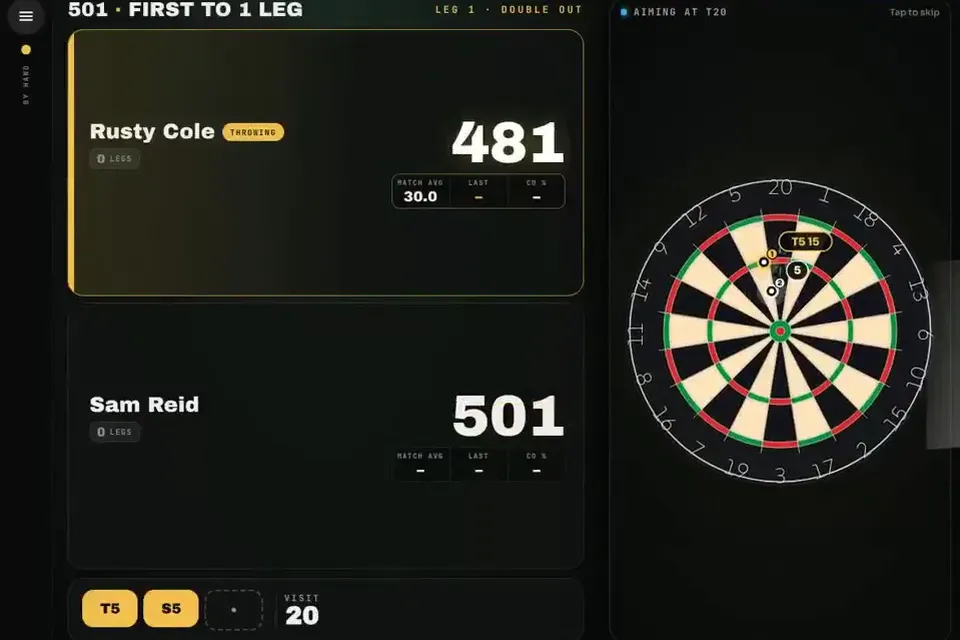
OCHE shows the route after every dart.
Let OCHE
do the maths.
OCHE does the subtraction, knows the bust rule and shows your checkout after every dart, on any board. Dartbot will play you if nobody else will.
- Live checkout routes after every dart
- Dartbot from pub to pro
- Every stat: average, first 9, checkout %, 180s
Ready to throw?
Get OCHE on iPhone, iPad, Android, Fire TV or the web. £1.99 a month free during beta, kids play free, and free for coaches and leagues.
Do you have to finish on a double in 501?
In standard 501, yes. The final dart must land in a double or the bullseye and bring you to exactly zero. Casual games sometimes play “straight out”.
What is a bust in darts?
A visit that takes you below zero, to exactly 1, or to zero without a double. It doesn’t count, and you go back to your score from the start of the visit.
What’s the highest checkout in 501?
170: treble 20, treble 20, bullseye.
Does the bull count as a double?
Yes. The red bullseye (50) counts as a double for finishing. The green outer bull (25) doesn’t.
What’s the fewest darts to win a leg of 501?
Nine: a nine-dart finish.
What’s the difference between 501 and 301?
Just the starting score. 301 is quicker and is often played double-in.