Schools · free worksheets

Darts maths for schools.

Six free printable worksheets for KS2 and KS3, from doubles and trebles to area and probability, with answers. Mental arithmetic that pupils actually want to do.

Why darts

Maths with a reason to get it right.

Every turn in darts is mental arithmetic: add three scores, double and treble, take it away from 501. Pupils do it because they want to know if they’ve won.

Times tables

Doubles and trebles are the 2 and 3 times tables, every throw.

Mental addition

Three darts, one total, before the next player steps up.

Subtraction

Counting down from 301 or 501 is subtraction with stakes.

Reasoning

Which double do I need? Why can’t I finish 169? That’s proof.

Statistics

Averages, medians and ranges from their own throws.

Area and probability

The board is circles and sectors, with real measurements.

Free worksheets

Six darts maths worksheets.

Three for KS2 and three for KS3, with teacher answers under each sheet. Print the page and the answers stay hidden unless you open them.

KS2 · Years 3–4

Doubles and trebles

A dart in the thin outer ring scores double. A dart in the thin inner ring scores treble. Fill in the table.

NumberDoubleTreble
1
2
3
4
5
6
7
8
9
10
11
12
13
14
15
16
17
18
19
20

Name: ______________   Class: ______

Teacher answers

1: 2, 3, 2: 4, 6, 3: 6, 9, 4: 8, 12, 5: 10, 15, 6: 12, 18, 7: 14, 21, 8: 16, 24, 9: 18, 27, 10: 20, 30, 11: 22, 33, 12: 24, 36, 13: 26, 39, 14: 28, 42, 15: 30, 45, 16: 32, 48, 17: 34, 51, 18: 36, 54, 19: 38, 57, 20: 40, 60
KS2 · Years 4–6

Three-dart totals

T means treble, D means double, 25 is the outer bull and Bull is 50. Add up each turn.

#Dart 1Dart 2Dart 3Total
1T2051
2D16203
3T19T72
425D1012
5T5T5T5
6BullD181
7T1320D4
8T17T18D9
98T11D12
10T20T20T20

Name: ______________   Class: ______

Teacher answers

1) 66, 2) 55, 3) 80, 4) 57, 5) 45, 6) 87, 7) 67, 8) 123, 9) 65, 10) 180

KS2 · Years 5–6

Count down from 301

In 301 you start on 301 and take away each score. Fill in what’s left after each turn. Then: can you finish 48 with one dart? Why not?

TurnScoredLeft
Start301
145
260
326
481
541

Name: ______________   Class: ______

Teacher answers

256, 196, 170, 89, 48. 48 can’t be finished with one dart: it would need double 24, and the board only goes up to double 20. Two darts work, e.g. 16 then double 16.

KS3 · Years 7–9

Checkout reasoning

You must finish on a double or the bull (50).

  1. Which scores from 1 to 40 can be finished with one dart? Describe the pattern.
  2. List every way to score 6 with one dart.
  3. The highest checkout is 170. Show how.
  4. Prove that 169 can’t be finished with three darts. (Hint: what’s the most two darts can score?)
  5. There are exactly two ways to finish 100 with two darts. Find them both.

Name: ______________   Class: ______

Teacher answers

1) Every even number from 2 to 40 (double 1 to double 20), plus 50 with the bull. 2) Single 6, double 3, treble 2. 3) T20 (60) + T20 (60) + Bull (50). 4) Two darts score at most 120, so the last dart would need to be 49 or more: only the bull (50) works, which needs 119 from two darts. No two single-dart scores make 119 (the top scores are 60, 57, 54, 51, 50, 48…, and 119 − 60 = 59, 119 − 57 = 62, both impossible). 5) T20 then D20, or Bull then Bull. (The last dart must be a double up to 40 or the bull; 100 − 50 = 50 needs the bull again, and the only double that leaves a one-dart score is D20, leaving 60 = T20.)

KS3 · Years 7–9

Darts averages

A darts player’s “three-dart average” is the points scored for every three darts thrown.

  1. A player scores 501 using 18 darts. What is their three-dart average?
  2. Six visits scored 60, 100, 45, 140, 81 and 75. Find the mean, median and range.
  3. What do you notice about the total of those six visits?
  4. A player’s average is 60. Roughly how many darts will they need for 501?

Name: ______________   Class: ______

Teacher answers

1) 501 ÷ 18 × 3 = 83.5. 2) Total 501, mean 83.5, median (75 + 81) ÷ 2 = 78, range 140 − 45 = 95. 3) It adds up to 501: a full leg in 18 darts. 4) 501 ÷ 60 ≈ 8.35 visits, so about 25 darts, more if the doubles go astray.

KS3 · Years 8–9

Area and probability

Measured from the centre: the double ring is 162–170 mm, the treble ring is 99–107 mm, and the bull has a radius of 6.35 mm. Use π ≈ 3.142 and round to the nearest whole number.

  1. Find the area of the whole scoring area (radius 170 mm).
  2. Find the area of the treble ring.
  3. What percentage of the scoring area is the treble ring?
  4. The treble ring is split into 20 equal beds. What’s the area of the treble 20 bed?
  5. Which is bigger: the bull or the treble 20 bed? By how much?
  6. If a dart lands at random in the scoring area, what’s the probability it hits treble 20?

Name: ______________   Class: ______

Teacher answers

1) π × 170² ≈ 90,792 mm². 2) π × (107² − 99²) = π × 1,648 ≈ 5,177 mm². 3) About 5.7%. 4) 5,177 ÷ 20 ≈ 259 mm². 5) Bull ≈ π × 6.35² ≈ 127 mm², so the treble 20 bed is about twice the size of the bull (about 132 mm² bigger). 6) 259 ÷ 90,792 ≈ 0.0029, about 0.29%, or roughly 1 in 350.

Curriculum

Where it fits in the curriculum.

Darts maths and the National Curriculum
StageDarts activityNational Curriculum link (England)
KS2 Y3–4Doubles and treblesRecall multiplication facts for the 2 and 3 times tables; mental calculation
KS2 Y4–6Three-dart totalsAdd numbers mentally, including three-digit totals
KS2 Y5–6Count down from 301Subtract mentally; solve multi-step problems
KS3Checkout reasoningReason mathematically; construct simple arguments and proofs
KS3Darts averagesMean, median and range from data
KS3Area and probabilityArea of circles; probability as a fraction, decimal and percentage

Safe in the classroom

Use magnetic or soft tip boards with younger pupils, set a clear throw line, and only one thrower at the oche at a time. With OCHE the board scores itself (or a pupil taps the score in), so the group checks the maths rather than waiting for it.

OCHE for schools

Maths that
hits the board.

Team games built for a class, scoring that runs itself, and safe accounts with no chat and no public leaderboards.

  • Games for groups so everyone plays
  • Any board: magnetic, soft tip, phone camera or tap
  • Kids play free
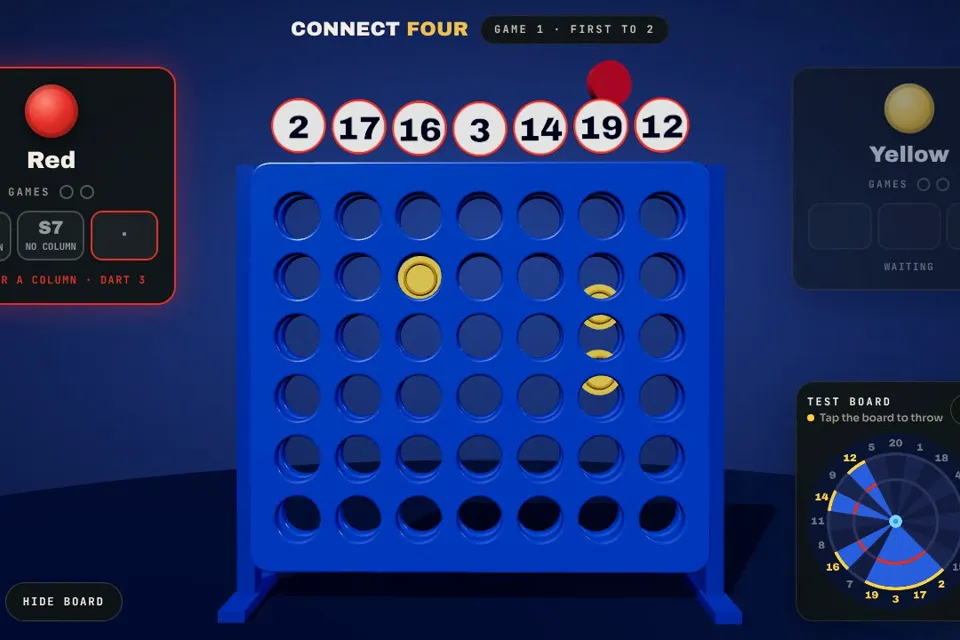
A Four in a Row darts game for a class
Join the beta

Ready to throw?

Get OCHE on iPhone, iPad, Android, Fire TV or the web. £1.99 a month free during beta, kids play free, and free for coaches and leagues.

Questions

Questions

Something else? See every question or email hello@ochegames.com.

How can darts help with maths?

Every turn is mental arithmetic: doubling, trebling, adding three scores and subtracting from 501, with a reason to get it right.

Are these darts maths worksheets free?

Yes. Print them from this page as often as you like. Teacher answers are under each sheet.

What age are the darts maths activities for?

Three sheets are for KS2 (Years 3–6) and three for KS3 (Years 7–9).

Is darts safe in school?

Use magnetic or soft tip boards, a clear throw line and one thrower at a time. Many schools run darts clubs safely this way.

Do we need a smart dartboard?

No. Any board works: with OCHE you can score with a phone camera or tap the scores in. OCHE for schools.

Why is 170 the highest checkout?

Two treble 20s make 120 and the bull, worth 50, is the biggest finishing dart: 120 + 50 = 170.

Join the betaWill it work?