A good darts night lives or dies on whether the games feel competitive. Put a 60-average thrower against a nervous beginner on a straight 501 leg and you already know the result before the first dart leaves the hand. A darts handicap system fixes that. It gives the weaker player a head start so that, on a good night, anyone can beat anyone. Done well, it is the single best tool a grassroots league has for keeping new players coming back.
This guide explains what a darts handicap actually is, the main systems leagues use, how to calculate one with a simple worked example, and the pitfalls to avoid so nobody feels cheated.
What is a darts handicap?
A handicap is a head start awarded to the weaker player (or team) to level a mismatch. Instead of both players starting a leg on 501 or 301, the handicap shortens the distance the weaker player has to travel — or lengthens it for the stronger one — so that each has a roughly equal chance of winning.
If you have ever played off a handicap in golf or bowls, the idea is identical: measure the gap in ability, then hand out an advantage that cancels it. In darts the gap is usually measured by three-dart average (3DA) — the average points a player scores per three darts thrown. A beginner might average 35–45; a steady pub player 46–55; a very strong club player 60-plus. (If you want to benchmark yourself, our guide to a good three-dart average breaks the numbers down.)
Leagues and clubs use handicaps for three big reasons:
- To welcome beginners. A newcomer who gets dismantled 9–0 rarely comes back. Give them a fighting chance and they stay.
- To keep fixtures meaningful. Mid-table-versus-top-of-the-table games stay watchable instead of being a formality.
- To mix abilities in one competition. You can run a single handicap league or cup instead of splitting everyone into tightly graded divisions.
Importantly, there is no single official darts handicap formula. Every league does it slightly differently, so the right answer is whatever your members understand and trust. Let us look at the common options.
The main darts handicap systems
1. Points head-start in X01
The most common pub and club method. Both players throw a normal leg of 501 (or 301), but the weaker player starts on a lower number, or is awarded free points before the first throw. For example, a strong player plays from 501 while a weaker opponent effectively only needs to score 361 — a 140-point head start. The bigger the ability gap, the bigger the head start.
2. Leg or game head-start
Instead of adjusting the score, you adjust the match. In a best-of-nine, the weaker player or team might start 2–0 up in legs. This is simple to run and easy to announce on the night, but it is a blunt instrument: a single leg is worth a lot, so handicaps jump in big steps rather than fine gradations.
3. Average-based handicap
The fairest and most popular approach for established leagues. You take each player's recorded three-dart average, work out the gap between the two players, and convert that gap into a points head-start per leg. Because it is driven by real, logged data, it self-corrects as players improve — but it only works if you are actually recording averages every week.
4. Percentage or points-per-dart handicap
A refinement of the average method. You compare each player's points-per-dart (PPD = 3DA ÷ 3) against the best player in that game, then scale the starting scores proportionally. It is accurate but less transparent, so it suits leagues happy to let software do the sums.
5. Default average for new and substitute players
Not a system on its own, but essential alongside any of the above. A brand-new player has no recorded average yet, so leagues assign a sensible league-wide default (say, a typical division average) until they have played enough legs to earn a real figure.
| System | How it works | Best for | Watch out for |
|---|---|---|---|
| Points head-start (X01) | Weaker player starts on a lower score | Pubs, casual club nights | Setting the gap by guesswork |
| Leg / game head-start | Weaker player starts legs up | Quick knockout cups | Big, clumsy steps |
| Average-based | Gap in 3DA converted to a points start | Established leagues with stats | Needs averages logged weekly |
| Percentage / PPD | Starting scores scaled by points-per-dart | Stat-driven leagues | Harder to explain to members |
| Default average | New players get a league baseline | Any league with newcomers | Setting the baseline too high or low |
How to calculate a darts handicap: a worked example
Let us run an average-based handicap for a 501 game using demo players.
Step 1 — Record each player's three-dart average. After a few weeks you have:
- Mia: 60
- Alex: 60
- Jo: 54
- Sam: 48
- Priya: 42
Step 2 — Convert to points-per-dart (PPD). Divide each 3DA by three. Mia is 20.0 PPD; Priya is 14.0 PPD.
Step 3 — Find the gap. Mia versus Priya: 20.0 − 14.0 = 6.0 PPD.
Step 4 — Multiply by the darts in a typical leg. A 60-average player clears 501 in roughly 24 darts. So the head-start is 6.0 × 24 = 144 points.
Step 5 — Round and cap. Round to a tidy 140. Priya now plays the leg needing only 361, while Mia plays the full 501. Two evenly matched players (Mia and Alex, both on 60) get no head-start at all — as it should be.
A few sensible rules make this hold together:
- Round to the nearest 10 or 20. Nobody wants to start on 347.
- Set a cap. Limit any head-start to, say, 200 points so a mismatch never becomes a walkover in reverse.
- Base averages on enough legs. One hot night is not a true average; use a rolling figure over several weeks.
- Agree the method before the season and write it into your rules so there are no arguments in week six.
Pitfalls: keeping it fair
Handicaps are only trusted if they are honest. The main dangers:
- Sandbagging. Some players deliberately underperform early to keep a generous handicap, then “suddenly” play brilliantly in the knockout. Using a rolling average from every logged game, not self-reported form, makes this much harder.
- Stale ratings. A player who has genuinely improved should see their handicap shrink. Re-rate everyone periodically — many leagues reserve the right to adjust ratings mid-season to keep parity.
- Averages that lie. A three-dart average does not capture everything; a player can score heavily but check out poorly. Treat the number as a strong guide, not gospel, and let your committee tweak obvious outliers.
- Over-complication. If your members cannot explain the handicap in one sentence, they will not trust it. Favour the simplest system that does the job.
How handicaps help grow a league
The real prize is retention. When a beginner knows they can beat an established name on handicap, darts stops being intimidating and starts being a night out worth returning to. Mixed-ability handicap leagues also let you welcome couples, workmates and whole pubs of varying standards into one competition instead of turning people away for being “not good enough yet.”
If you are setting one up from scratch, our guide on how to start a darts league covers fixtures, divisions and rules, and you can round up your first sides with a little help from our darts team names list. For players who want to close that handicap gap the honest way, point them at practice drills and training.
Where OCHE fits in
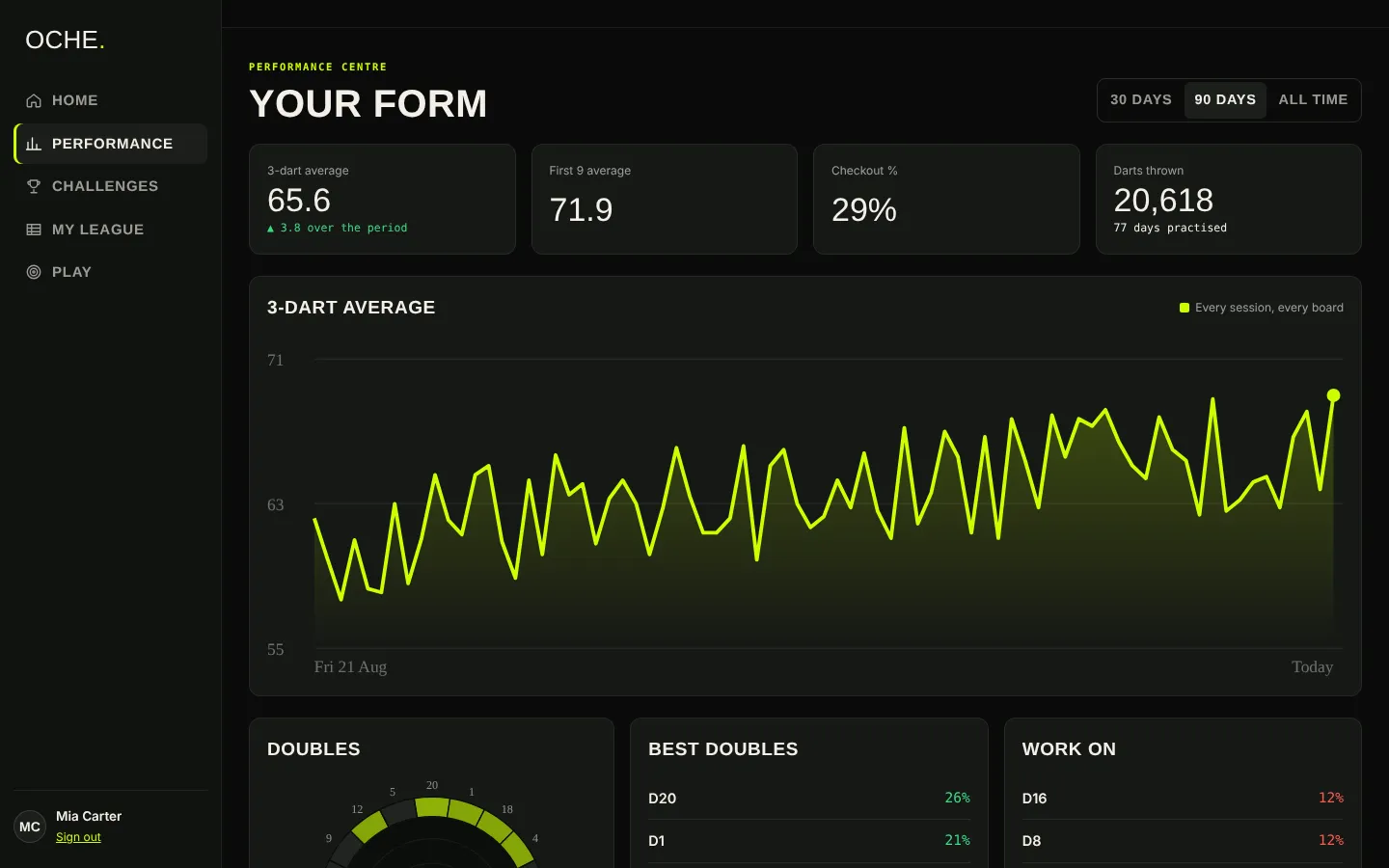
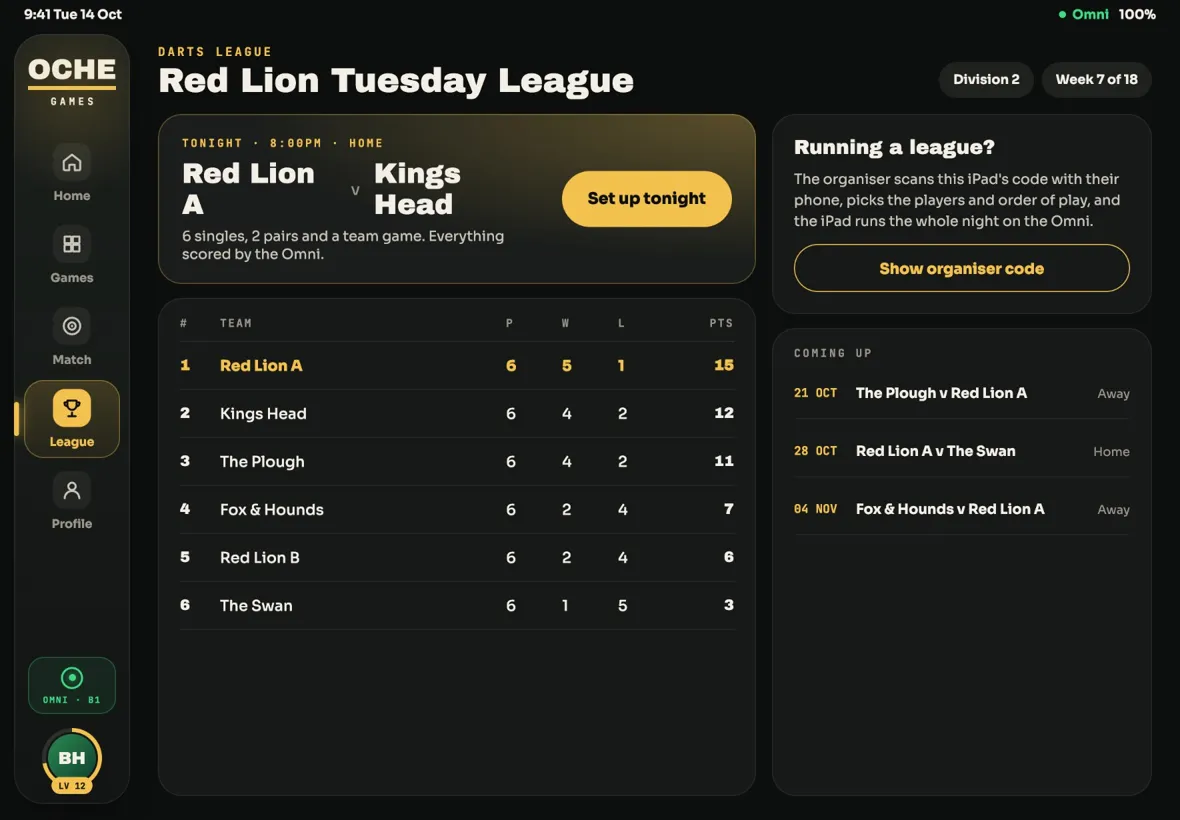
Every handicap system above runs on one thing: knowing each player's true standard. That is where recorded data does the heavy lifting. OCHE's free league software handles fixtures, tables and player management, and it logs every player's three-dart average game after game — which is exactly the number you base an average-based handicap on. You still decide and apply the handicap formula that suits your league, but you are working from real, up-to-date averages rather than gut feel or scribbled notes.
You can set up a free league page, add your players and start building those averages at OCHE Leagues. From there, choosing and running a fair handicap is a far shorter walk.
Conclusion
There is no universal darts handicap system — and that is fine. Whether you hand out points in 501, start the underdog a leg up, or convert three-dart averages into head-starts, the goal is the same: make every game feel winnable. Pick the simplest method your members will trust, base it on real averages, cap it, re-rate regularly, and you will have a league where a beginner can topple a champion on any given night. That is how grassroots darts grows.
Common questions
What is a darts handicap system?
It is a way of giving the weaker player or team a head start so a mismatch becomes a fair contest. Usually the weaker player starts a leg on a lower score (for example 361 instead of 501) or starts the match a leg or two ahead, with the size of the head start based on the gap in ability.
How do you calculate a darts handicap?
The common average-based method compares both players' three-dart averages, converts the gap into points-per-dart, then multiplies by the darts in a typical leg to get a points head start. For example, a six points-per-dart gap over a 24-dart leg gives roughly a 140-point head start, which leagues then round and cap.
What three-dart average counts as beginner or pub standard?
As a rough guide, beginners average around 35 to 45, steady pub and club players around 46 to 55, and strong players 60-plus. These are only benchmarks, but they show why a handicap matters: the gap between a beginner and a club player is large enough to decide most legs before they start.
How do you stop players abusing the handicap (sandbagging)?
Base handicaps on a rolling average from every logged game rather than self-reported form, re-rate players periodically through the season, and cap the maximum head start. If ratings come from real recorded data, it is very hard for a player to fake a weak average and then over-perform when it matters.
Does OCHE apply handicaps automatically?
OCHE's free league tools handle fixtures, tables and player management and log every player's three-dart average, which is the number you base a handicap on. You choose and apply the handicap formula that suits your league using those recorded averages.