Ask ten players what counts as a good three-dart average and you'll get ten different answers, usually inflated by the one 140 they hit last Tuesday. The honest truth is that a good three-dart average depends entirely on where you're playing and who you're playing against. A number that would win you the pub league might get you knocked out in the first round of a county qualifier.
This guide gives you real, no-nonsense benchmarks by skill level, explains exactly how the figure is worked out, shows where the PDC pros actually sit, and lays out a practice structure that genuinely moves the needle. No fluff, no "just throw more darts" — proper targets you can measure yourself against.
How a three-dart average is calculated
Your three-dart average is the number of points you'd expect to score, on average, with each visit of three darts. It's the single most useful number in darts because it strips out luck and tells you how you're really playing over time.
The maths is simple:
Three-dart average = (total points scored ÷ total darts thrown) × 3
So if you play a leg of 501, finish it, and it took you 18 darts, your average for that leg is (501 ÷ 18) × 3 = 83.5.
A few things worth knowing:
- It's always quoted per three darts, even though it's calculated per dart. That's why pub players talk about "a 60 average" and pros talk about "a ton" (100+).
- The bust rule doesn't change the maths — you're measured on points that counted toward the checkout, across the darts you actually threw.
- One leg tells you very little. A session or monthly average across dozens of legs is what reveals your real standard, because it smooths out the hot legs and the horror shows alike.
This is also why tracking by hand is a pain: you'd need to log every dart of every leg and do the arithmetic each time. It's exactly the sort of thing that should happen automatically while you play — more on that at the end.
Benchmark table: beginner to pro
Here's where a good three-dart average actually lands, by level. These figures reflect singles play at the standard oche distance of 7ft 9¼in, throwing at a regulation board.
| Level | Three-dart average | What it looks like |
|---|---|---|
| Complete beginner | Under 40 | Still finding the treble bed; plenty of darts in the 1, 5 and 20 singles |
| Casual / improving | 40–50 | Hits the odd 60, can find the 20 bed semi-reliably |
| Solid pub player | 50–60 | Regular 45s and 60s, starting to understand checkouts |
| Strong pub / Sunday league | 60–70 | Finds trebles under light pressure, knows the common finishes |
| Good league player | 70–80 | Consistent scoring, works a route to a double |
| County / top amateur | 80–95 | Reliable 100+ visits, confident two-dart finishing |
| Tour-card hopeful | 90–100 | Sustained ton-plus scoring under pressure |
| PDC professional | 95–105+ | Punishes any loose leg; elite players live above 100 |
What counts as a good three-dart average for most people reading this? If you play in a pub or Sunday league, anything north of 60 is genuinely respectable, and breaking 70 puts you among the better players in most local sides. Crossing 80 is the point where you'd be competitive at open and county level — a serious achievement that most players never reach.
Don't be discouraged if you're in the 40s. That's a normal, honest starting point, and the gap from 45 to 60 closes faster than you'd think with structured practice.
Where PDC pros actually sit
There's a lot of myth about pro averages, so let's be precise.
A tournament-winning average on the PDC circuit typically lands between 95 and 100. In a big televised final, the champion is often in that range across the whole match. Anything over 100 for a full match is an outstanding performance, and the very best players — the Luke Humphries, Luke Littler and Michael van Gerwen tier — can string together matches well above it.
The headline records sit higher still:
- The highest average in a televised match is over 123 (Michael van Gerwen, 2016 Premier League) — a freakish, barely-repeatable standard.
- A nine-dart finish is the perfect leg: 501 in nine darts, which is a single-leg average of 167. Pros manage them, but even for them they're rare and celebrated.
The key takeaway: even world champions don't average 120 across a match. When you measure yourself against 95–100 as the elite professional benchmark, you're comparing against reality, not highlight reels. A good three-dart average for a club player and a pro's match average are separated by a huge, hard-won gulf — which is exactly why the number is worth tracking as you climb.
How to improve your average (practice structure)
Averages don't improve by throwing aimlessly for an hour. They improve when practice is structured, measured and slightly uncomfortable. Here's a framework that works at every level.
1. Build a scoring base
Most of your average comes from scoring, not finishing. Spend the bulk of your practice on the treble 20 (and treble 19 as a backup). A simple, brutal drill:
- Throw sets of three at the T20.
- Score 0 for a single 20, points as hit for anything in the treble.
- Track your per-visit average over, say, 20 visits.
Chasing that number upward week on week is how pub players get from the 50s into the 60s and 70s.
2. Drill your finishing
You can't win legs you can't close. Practise the common checkouts relentlessly — 40, 32, 36, 60, 61, 81 — and learn the standard routes so you're never doing mental arithmetic mid-leg. A reliable two-dart finish is often worth more to your match average than another five points of scoring, because it saves whole visits. Our checkout calculator is a handy reference while you drill.
3. Practise under pressure
Scoring well in an empty room is easy. Add stakes: play "double or nothing" on your finishes, or set a target average for the session and make yourself restart if you drop below it. Pressure is a skill, and it's the first thing that collapses in a real match.
4. Measure everything
This is the part most players skip, and it's the part that matters most. You cannot improve what you don't track. You need to know:
- Your rolling three-dart average (this week vs last month).
- Your first-nine average (how fast you start a leg).
- Your checkout percentage.
Without those numbers, "am I getting better?" is just a feeling. With them, it's a trend line.
For a deeper breakdown of drills by discipline, our darts practice games guide and the OCHE training section go further — including routines built specifically around raising your average rather than just passing time.
Track your average automatically in OCHE
Here's the honest problem with everything above: doing the maths by hand, every leg, is a chore — and the moment it becomes a chore, you stop. That's where auto-scoring changes the game.
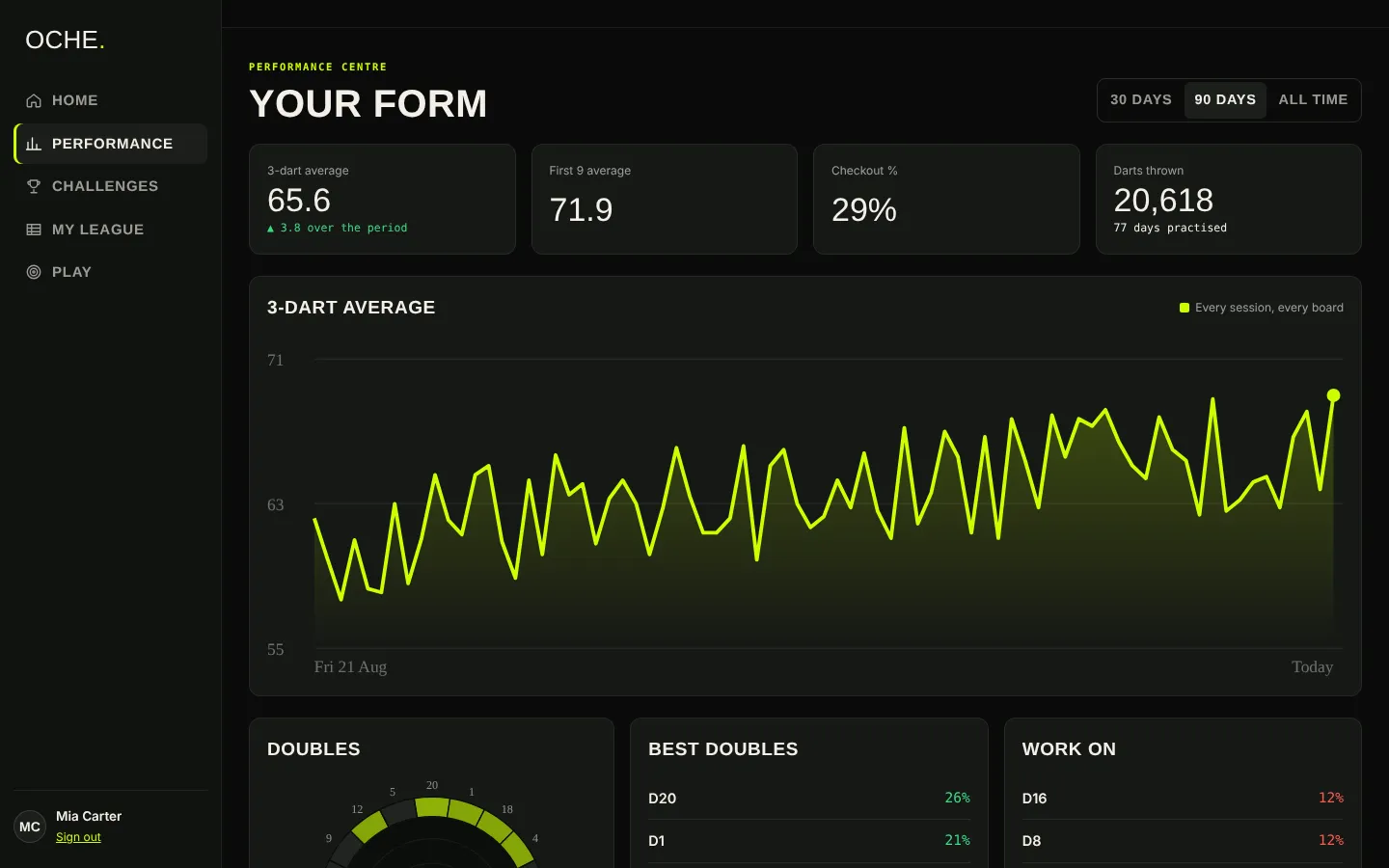
OCHE tracks your three-dart average automatically, leg by leg and session by session, whichever way you score — tap it in, call it out by voice, use your phone's camera, or let a smart board like the Target Omni, Scolia or Unicorn SEER do the counting. Every number in this article — rolling average, first-nine, checkout percentage — is logged for you and charted over time, so you can actually see the 55 become a 62 become a 70.
You don't need to be chasing a tour card to care about this. Watching your own average climb is one of the most satisfying things in the sport, and it's the clearest possible proof that your practice is working.
Want to know your real number — and watch it go up? Point OCHE at your board, play as you normally would, and let it keep score. Start tracking your three-dart average in the OCHE app and find out exactly where you sit.
Common questions
What is a good three-dart average for a beginner?
For a complete beginner, anything in the 30s to low 40s is a normal and honest starting point. Once you can find the treble 20 bed semi-reliably, you'll push into the 45–55 range. The jump from the mid-40s to 60 comes surprisingly quickly with structured scoring and finishing practice.
What is a good three-dart average for a pub or league player?
In most pub and Sunday leagues, anything above 60 is genuinely respectable and breaking 70 puts you among the stronger players in your side. Crossing 80 makes you competitive at open and county level, which most players never reach.
What three-dart average do PDC professionals have?
A tournament-winning average on the PDC circuit is typically 95–100 across a match. Averaging over 100 for a full match is an outstanding performance. The elite tier can sustain higher, but even world champions don't average 120 over a whole match — the televised record of over 123 is a one-off, barely-repeatable feat.
How do you calculate a three-dart average?
Divide your total points scored by the number of darts thrown, then multiply by three. For example, finishing a 501 leg in 18 darts gives (501 ÷ 18) × 3 = 83.5. It's always quoted per three darts, and a session or monthly average is far more meaningful than a single leg.
What's the fastest way to improve my three-dart average?
Spend most of your practice on treble-20 scoring, drill the common checkouts (40, 32, 36, 60, 81) until the routes are automatic, practise under some form of pressure, and — crucially — track your numbers so you can see the trend. Measuring your rolling average and checkout percentage is what turns vague effort into real improvement.